Feed-In Tariffs Explained For Wollongong Solar Owners
Most solar owners focus on what the panels save them at the point of use, but there is a second stream of value worth understanding: what you earn when exporting solar energy to the grid. That surplus gets exported when your system produces more than the household can use, and your retailer pays you a rate for it. That rate is your feed-in tariff, and understanding NSW feed-in tariff rates and feed-in tariff Wollongong solar owners receive is one of the few ongoing variables in the system's economics worth reviewing every year.
What Is A Feed-In Tariff And How Does It Work
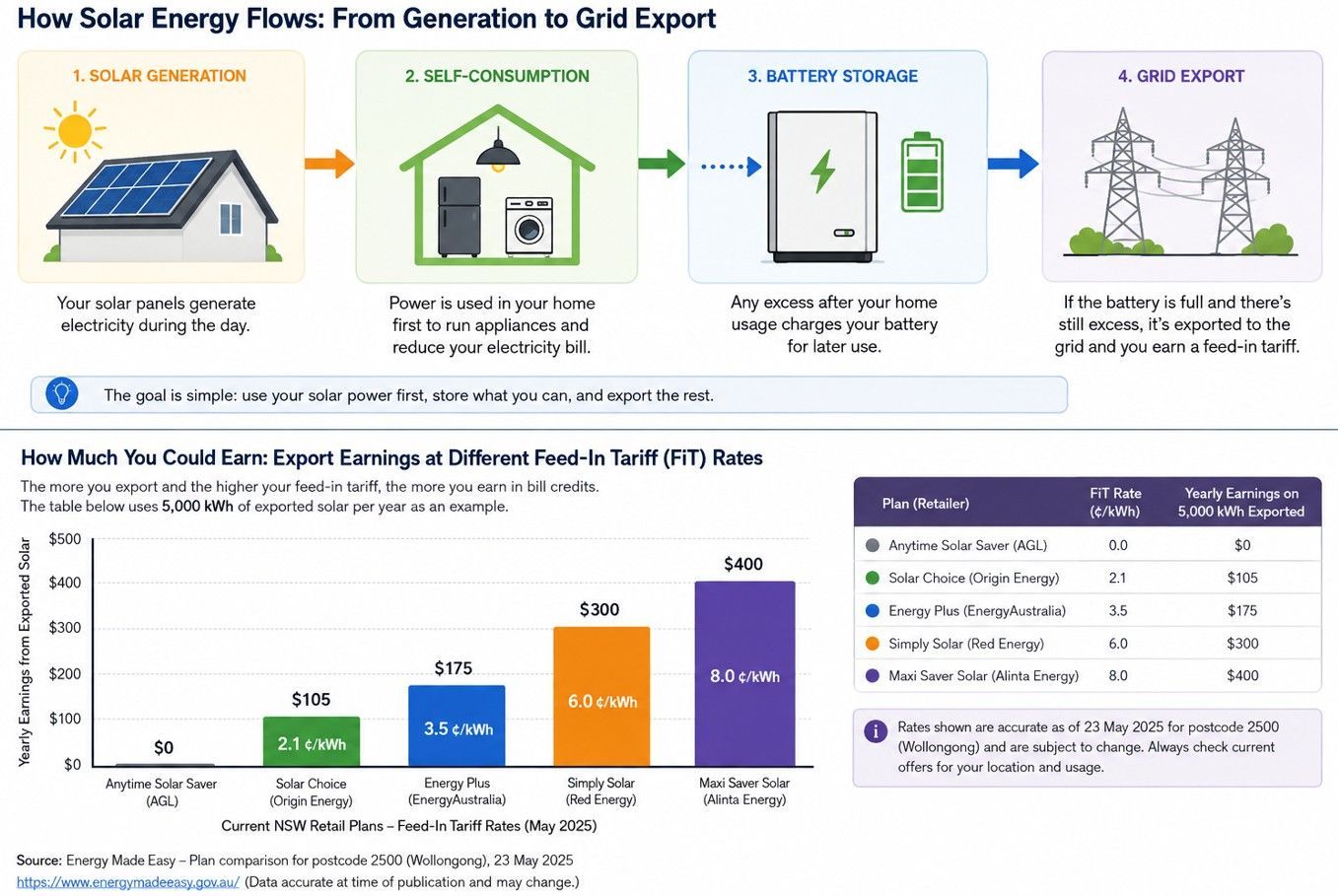
A feed-in tariff (FiT) is the per-kilowatt-hour rate your electricity retailer pays for solar energy your system exports to the grid. When your panels produce more power than your home is drawing at that moment — during the middle of the day when nobody is home, for example — the excess flows out through your meter and your retailer credits you for it on your bill.
The amount you export versus consume depends on your household's usage profile. A household that is largely empty during the day tends to export more. A household with high daytime consumption — ducted air conditioning, a pool pump, an EV charging during the day — will self-consume more and export less.
The FiT applies only to what you actually export. It does not change what you save by consuming your own solar generation directly. Those two figures — self-consumption savings and export earnings — make up the combined financial return of a solar system. For solar panels Wollongong homeowners already have installed, feed-in tariffs are one of the few ongoing variables worth checking each year.
Current Feed-In Tariff Rates For NSW Households
NSW does not operate a government-mandated feed-in tariff. Instead, retailers set their own export rates competitively, which means the rate varies from retailer to retailer and can change at the time of contract renewal. The Australian Energy Regulator (AER) publishes guidance on minimum retailer obligations in NSW, but there is no floor rate retailers are required to offer. As a result, FiT rates across NSW retailers can vary meaningfully — which is why comparing offers at renewal time matters more in NSW than in some other states.
In general terms, NSW FiT rates have trended lower over time as solar uptake has grown and daytime grid prices have responded. This makes reviewing your plan annually worthwhile — the rate you were offered when your system was installed may no longer be competitive, and switching retailers (while keeping your current tariff structure) is straightforward in the deregulated NSW market.
For a current comparison of available rates, resources like the NSW Government's Energy Made Easy website allow you to filter offers by your postcode and usage profile, including the export rate each retailer is offering.
How Much You Could Earn From Exported Solar Energy
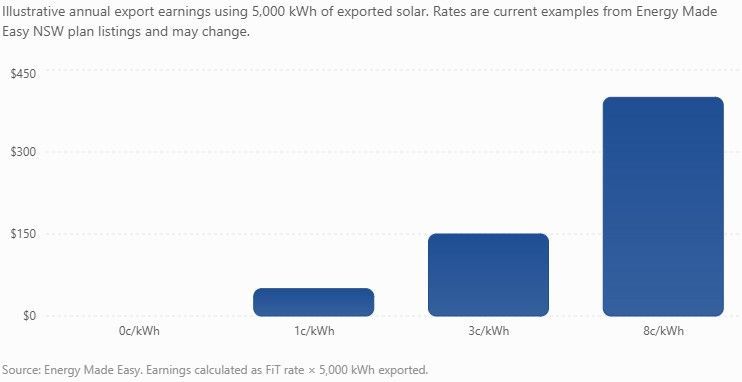
How much you earn from exported solar depends on three things: how much you export, the rate you receive, and how that interacts with your bill. A typical residential solar system produces more than the average household can self-consume on a standard weekday. The exported portion — often a significant share of total generation for homes with working occupants — accumulates as credits on your electricity bill throughout the year.
The financial value of those credits is directly proportional to the FiT rate. At a higher export rate, the same volume of exported energy produces more bill offset. At a lower rate, self-consumption becomes relatively more valuable by comparison, because every kilowatt-hour you use yourself is one you do not need to buy at the full retail rate. This relationship between export rate and retail rate is important to understand. The wider the gap between what the retailer pays you for exports and what you pay them for imports, the more valuable daytime self-consumption becomes relative to exporting. Feed-in tariffs are only one part of the picture. For the full breakdown, see how long before you break even on a typical Wollongong system.
Feed-In Tariffs Vs. Battery Storage: Which Makes More Sense
The comparison between earning a feed-in tariff and storing surplus energy in a battery comes down to the economics of each option at your specific FiT rate and retail rate.
When the FiT rate is high relative to the retail rate, exporting surplus energy and earning credits can be financially competitive with storing it. When the gap widens — when export rates are low and retail import rates are high — storing that energy in a battery and using it in the evening becomes more valuable than exporting it.
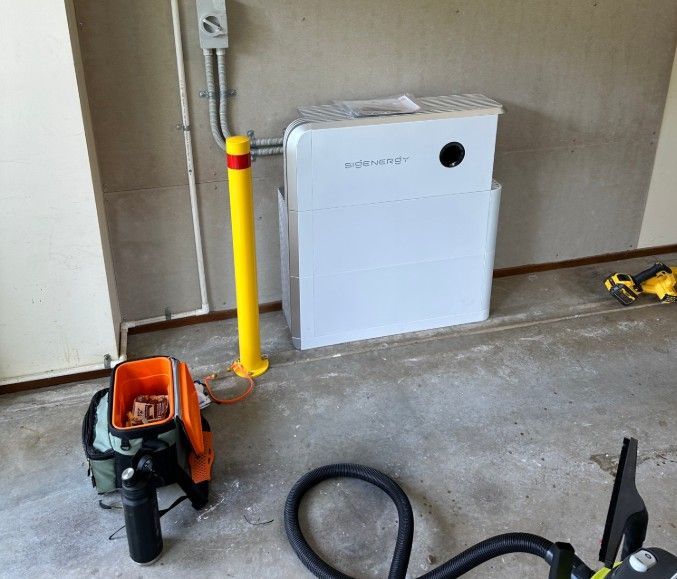
The trend in NSW has generally been toward lower FiT rates and higher retail rates over time, which has shifted the economics increasingly toward battery storage for households that generate significant surplus. Once your feed-in tariff drops below what you would save by using the power yourself, solar batteries usually start to make more financial sense. It is worth noting that a battery does not eliminate export earnings — if the battery is full and the panels are still generating, surplus still exports to the grid. A battery simply captures what would otherwise have been exported at the FiT rate and makes it available for use later at the higher retail rate.
How To Make Sure You're On The Best Available Rate
Reviewing your feed-in tariff does not require switching energy providers — though that is an option. Several steps are worth taking:
- Check your current export rate on your bill or in your retailer's online portal. The FiT rate should be listed clearly in your tariff details
- Compare current offers using the NSW Energy Made Easy comparison tool, filtering for your location and a system of your approximate output size
- Consider your usage profile — if your household has high daytime consumption, a marginally lower FiT may matter less because you are already self-consuming more of your generation
- Factor in the full tariff structure — a retailer offering a slightly lower FiT but a significantly better import rate may represent better overall value depending on your usage
- Ask about time-of-use rates — some retailers offer higher export rates during peak demand periods, which can benefit systems that export more in the afternoon
Our solar installation Wollongong team can also check whether your current retailer plan still offers a competitive export rate — it is worth including in any annual system review.
We at Solarblu Pty Ltd work with homeowners across the Illawarra and South Coast to help them get the most from their solar systems, from initial installation through to ongoing performance. Call us on 02 4262 6622 or visit our website to speak with our team about your solar setup.